Thursday, November 12, 2015

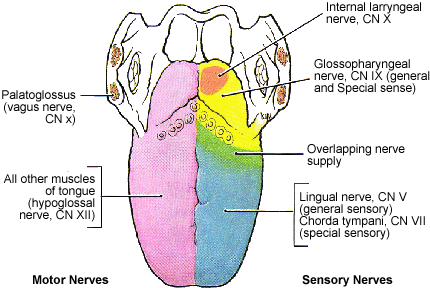
tongue


tongue nerve supply 


Kiesselbach’s area.


Branching from the maxillary artery, thesphenopalatine artery enters the nasal cavity via the sphenopalatine foramen and supplies the septal wall of the cavity. Entering through the orbit, the septal branches of the anterior and posterior ethmoidal arteries (branches of the ophthalmic artery) gives supply to the roof as well as the septal wall of the cavity as it travels to Little’s area. 
The facial artery gives off the superior labial artery; the septal branch of which enters the nasal cavity through the nares and joins the anastomoses in Little’s area. The greater palatine artery, a terminal branch of the maxillary artery, passes through the greater palatine foramen and travels along the hard palate to enter the nasal cavity by way of the incisive canal, thus joining the anastomosis in Kiesselbach’s area.


Tuesday, November 10, 2015

facts


 Patient Hygiene Performance (PHP) Index 

The Patient Hygiene Performance (PHP) Index  was first used as an oral hygiene assessment method when working with patients. Oral debris for the PHP Index is defined as soft foreign matter consisting of bacteria, mucin, and food loosely attached to tooth surfaces. Teeth are disclosed and a mouth mirror examination is made of specific teeth. The examiner mentally divides each tooth into five subsections and determines the presence or absence of oral debris on each of the subdivisions. Summing the values for each of the five subdivisions provides the oral debris score for the tooth. An overall patient hygiene performance score is tabulated by dividing the sum of the tooth scores by the number of surfaces charted. 


Basement membrane (type IV) collagen

The collagen IV molecule is 400 nm long and consists of two alpha 1 (IV) and one alpha 2 (IV) chains. Their genes COL4A1 and COL4A2 form a transcription unit in which they are arranged head-to-head and connected by a short common promoter region.


cotton wool appearance

 pagets disease

Adenoid cystic carcinoma


Adenoid cystic carcinoma; cribriform or “Swiss cheese” pattern that is unmistakable but not always present. The cells show scanty cytoplasm and round to ovoid basophilic nuclei of regular form. The circular areas containing weakly eosinophilic amorphous basement membrane material accounting for the synonym “cylindroma.” Mucous and serous glands and the ducts of normal submandibular salivary gland are seen on the left. The gland was not invaded.

Monday, November 2, 2015

Allodynia


Allodynia (pain due to a stimulus that does not usually provoke pain) and hyperalgesia (increased pain from a stimulus that usually provokes pain) are prominent symptoms in patients with neuropathic pain. Both are seen in various peripheral neuropathies and central pain disorders, and affect 15–50% of patients with neuropathic pain. Allodynia and hyperalgesia are classified according to the sensory modality (touch, pressure, pinprick, cold, and heat) that is used to elicit the sensation. Peripheral sensitisation and maladaptive central changes contribute to the generation and maintenance of these reactions, with separate mechanisms in different subtypes of allodynia and hyperalgesia. Pain intensity and relief are important measures in clinical pain studies, but might be insufficient to capture the complexity of the pain experience. Better understanding of afllodynia and hyperalgesia might provide clues to the underlying pathophysiology of neuropathic pain and, as such, they represent new or additional endpoints in pain trials.

Friday, October 23, 2015

CARIOGRAM


Douglas Bratthall and coworkers at the Dental School in Malmö have attempted to make the practical application of risk assessment more accessible by developing a computer-based caries risk assessment model called CARIOGRAM.

Cariogram - the five sectors The Cariogram, a pie circle-diagram, as seen in the screen, is divided into five sectors, (see figure below) in the following colours: green, dark blue, red, light blue and yellow indicating the different groups of factors related to dental caries. An explanation of each sector follows below.


1.The green sector shows an estimation of the ‘Actual chance to avoid new cavities’. .The green sector is ‘what is left’ when the other factors have taken their share.

2.The dark blue sector ‘Diet’ is based on a combination of diet contents and diet frequency.

3.The red sector ‘Bacteria’ is based on a combination of amount of plaque and mutans streptococci.

4.The light blue sector ‘Susceptibility’ is based on a combination of fluoride program, saliva secretion and saliva buffer capacity.

5.The yellow sector ‘Circumstances’ is based on a combination of past caries experience and related diseases.


ADULT SKULL

In humans, the adult skull is normally made up of 28 bones. Except for the mandible, all of the bones of the skull are joined together by sutures, rigid articulations permitting very little movement.

At birth, the human skull is made up of 45 separate bony elements. As growth occurs, many of these bony elements gradually fuse together into solid bone (for example, the frontal bones).

* frontal bone
* parietal bone (2)
* temporal bone (2)
* occipital bone
* sphenoid bone
* ethmoid bone

Facial bones

* mandible
* maxilla (2)
* palatine bone (2)
* zygomatic bone (2)
* nasal bone (2)
* lacrimal bone (2)
* vomer bone
* inferior nasal conchae (2)